
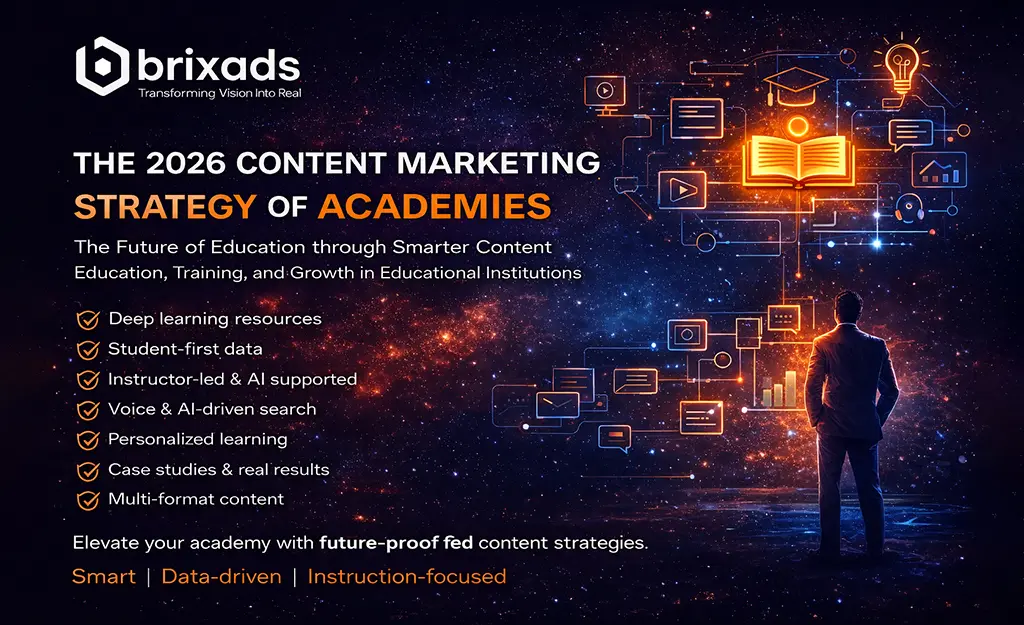
The 2026 Content Marketing Strategy of Academies
The Future of Education through Smarter Content Education, Training, and Growth in Educational Institutions
➔ Introduction
The content marketing approach of 2026 towards academies will not further be the one of publishing lessons every now and then, but instead the one of developing learning resources which will be intelligent, data-driven, experiences-based, and reliable.
Students are also more picky, search engines are more people oriented and academies need to modernize their instructional method to stay competitive and afloat in the future.
This guide disaggregates the most efficient content plans of the next decade 2026 that all academic buildings, institutes and training centers must employ in order to recruit, establish authority and provide meaningful education.
1. Power Content More than Volume
In 2026, colleges in which students learn in-depth, proficiency and in the actual classroom will prevail. Communicating worthlessly frequently will not.
Authoritative instruction demands:
- Real teaching expertise
- Instructor-led insights
- Real-life examples in the classroom
- Niche subject knowledge that the students are taught
It is not just the deep content production but depth matters. The ways that academies can do this:
- Cut back on generic courses and introduce high-quality researched courses
- Educate using the real world case studies rather than superficial theory
- Incorporate real life scenarios that can be identified with
2. Student Learning Data Content Strategy First Parties
With a privacy shift and a cookieless world as the new reality, academies need to use data obtained by themselves to know students in a more intimate way. The optimal content of learning will be constructed according to rather what is needed by the students than presumed.
The main first-party data that needs to be gathered among students:
- Email sign-up behavior
- Navigating a Web site and interested in a course
- Student surveys and feedbacks
- CRM and CRM patterns inquiry patterns
- Questions posted via chat, email and phone
It aids academies in developing lessons that address existing problems of students, enhance the design of courses and customize the learning paths.
3. Not Stylistically a Machine, but Real Teachers Write the Content
The content taught by humans is rewarding by search engines. Qualified instructors are also trusted by students not by robotic writing.
2026 SEO prioritizes:
- Human teaching experience
- True instructor credibility
- Classroom-driven insights
- The professional competence exhibited
The AI will be capable of organisation of the content, but the knowledge of the instructors cannot be guided by them. Human-assisted AI-driven content will be more effective than AI-based notes.
4. The Voice and AI Search Learning Format
Learners do not use keywords anymore. They search like they speak. Instead of:
best CRM
Students now ask:
What is the recommendation to a beginner student when it comes to the use of CRM tool in small business management?
Academies should adapt:
- Write the questions in question form
- Add FAQs at the end of each large lesson
- Include some natural conversational responses
This will make the students locate your academy using the smart speakers, artificial intelligence helpers, and voice search.
5. Individualized Student Learning
The education of 2026 needs individual learning patterns.
The segmentation of students should be done according to:
- Basic, intermediate, and advanced levels
- Skill intention and learning outcome
- Industry or career goals
- Budget preparation to take up courses
- According to the engagement and level of interest
Individualization enhances trust, higher completes, and better admissions.
6. Classroom Content Based on Case Study
It is not what they are told that students believe but what they can see. Where the academies ought to make display:
- Curriculum and manuals of the course
- Material and worksheets used in classrooms
- Posts on LinkedIn CVs must be credible
- Email nurturing sequences
- Webinars and live workshops
Case studies form the most powerful type of educational materials in 2026.
7. Artificial Intelligence-Based Education
The role of AI is to assist the educator and not to substitute the educator. Academies which are fully reliant on AI generate generic lessons. The ones who utilize AI as an aid develop high quality learning content.
Winning formula for 2026:
Experience in human workers + AI help + scientifically organized education
This equilibrium results in an improved level of learning, increased trust and academic credibility.
8. Student Multi-Format Content Distribution
Learning will no longer exist in a limited format as a website or classroom in 2026. On various platforms, students imbibe knowledge.
Academies are supposed to dispensational educational content via:
- Website blog + SEO lessons
- Academic + authority building on LinkedIn
- Email + intelligent learning journeys
- Podcasts + expert interviews
- Webinars + training workshops
A balanced content strategy will not only educate the students, but will also bring in new enrollments.
➔ Conclusion
The 2026 content marketing plan of the academies concerns depth, smartness, and authorization of learning. It is not a question of frequency, or of quantity, but rather a question of quality. Effective academies will be learners with instruction in first hand expertise, collect their own direct student data, voice and AI search functionality, learning journeys, and real world examples that earn trust.
With these principles in play, both large and small academies will gain student trust, courses enrolments, on-line awareness, and ultimately long term growth of an institution. The future of education will be in the academies that are more authentic and supported by the modern content strategy.
➔ FAQ
Q1: Is authoritative content still required in academies?
Yes. Academies are trusted by the students based on disseminating knowledge and expertise, real life cases and experienced tutors.
Q2: Could blogging be of use to an academy in 2026?
Yes. Educational blogs are appealing to students and they enhance admissions and the authority of the subject.
Q3: Will AI replace teachers?
Yes or No. AI can assist the teaching process, however, the experience of an instructor,his or her judgment, and the human face of the classroom-based guidance cannot be replaced.